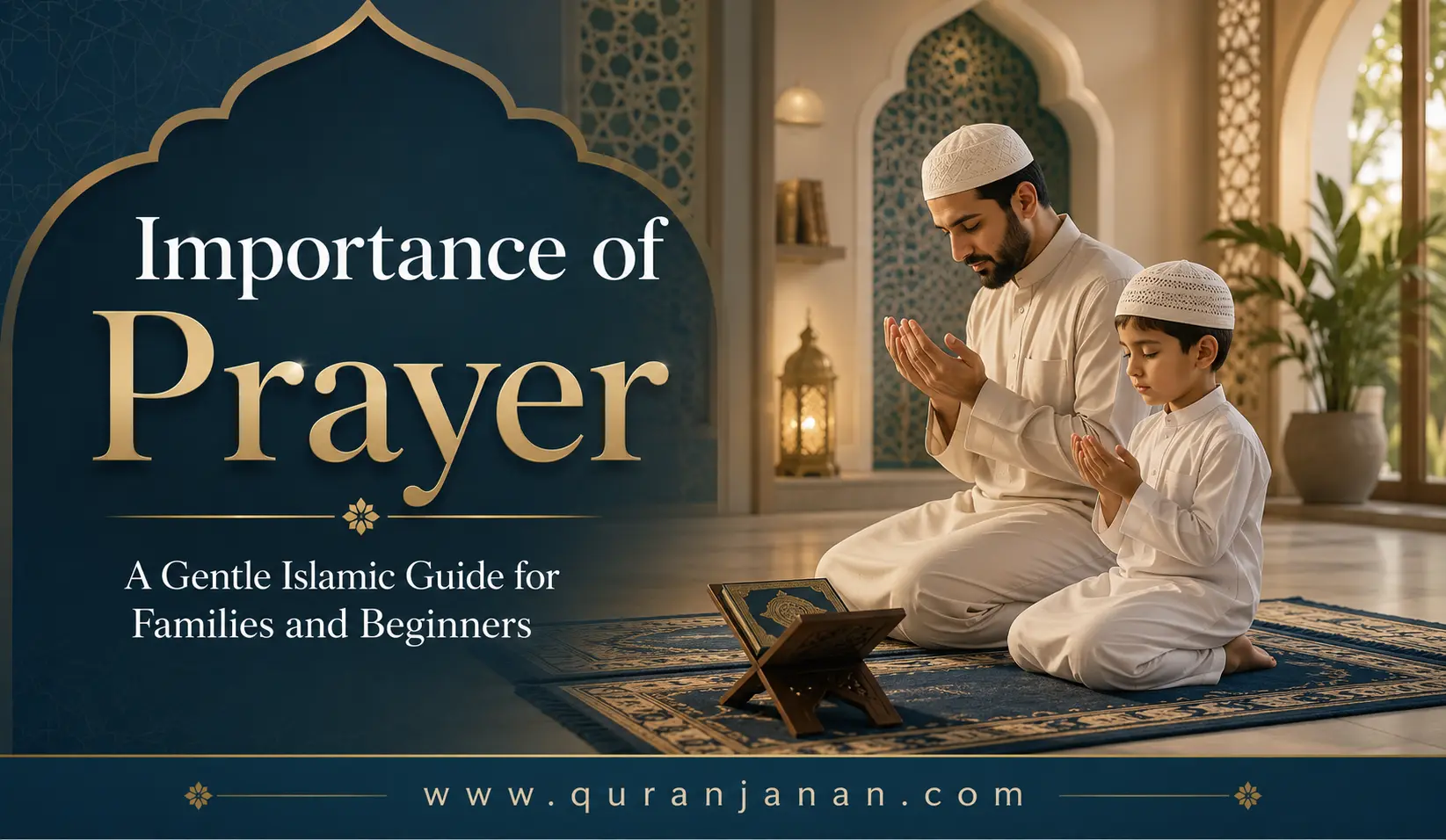
The importance of prayer in Islam is that Salah connects a Muslim directly with Allah, builds discipline, cleans the heart, and keeps daily life spiritually balanced.
Prayer is not only a ritual; it is a daily act of worship, remembrance, humility, and obedience to Allah.
For Muslim families and adult beginners, learning prayer with Quran reading, dua, and gentle consistency can transform the home environment.
Introduction
A father hears the Adhan after a long day. His child is doing homework, dinner is almost ready, and everyone feels tired. For a moment, he thinks, “We’ll pray later.” Then he looks at his child and quietly says, “Come, let’s pray first. Everything else can wait.”
Many Muslim families face this daily moment. They know prayer is important, but busy routines, school, work, screens, and tiredness can make Salah feel delayed or difficult.
The importance of prayer is that it keeps a Muslim connected to Allah throughout the day. Prayer reminds the heart of purpose, teaches discipline, strengthens faith, and brings peace into family life.
In this guide, you’ll learn what the importance of prayer means, why Salah matters in Islam, what scriptures on the importance of prayer teach, how fasting and prayer support each other, common mistakes to avoid, and how Quran Janan Academy helps families build Quran and Salah confidence.
What Is the Importance of Prayer?
Simple Definition
The importance of prayer means understanding why Salah matters in a Muslim’s life: it is a daily connection with Allah, a form of worship, and a way to remember Him regularly.
In Islam, prayer is not only a private habit. It shapes time, character, family routine, and spiritual awareness. Traditional Islamic education teaches that Salah should be performed with respect, focus, and sincerity.
Common Misconception
A common misconception is that prayer is only a duty to “finish.” This view can make Salah feel heavy.
Prayer is an obligation, but it is also mercy. It gives the heart a place to return to Allah five times a day. It helps a person pause, repent, make dua, and remember that life is not only about work, money, or daily stress.
Another misconception is that children will automatically understand Salah if they simply see adults praying. Seeing is powerful, but children also need gentle explanation. They need to know why we pray, whom we are standing before, and how prayer connects with the Quran.

Question: What is the importance of prayer?
The importance of prayer is that it connects a Muslim with Allah, strengthens faith, builds discipline, and brings spiritual peace. In Islam, Salah is a central act of worship that reminds Muslims of Allah throughout the day.
Why Is the Importance of Prayer So Great in Islam?
The importance of prayer is great because Salah is one of the most central acts of worship in Islam. Muslims pray to remember Allah, seek guidance, show humility, and keep their hearts alive.
The Quran repeatedly reminds believers to establish prayer. Surah Al-Ankabut 29:45 teaches that prayer helps restrain from shameful and wrong actions. Surah Taha 20:14 connects prayer with remembering Allah. Surah Al-Isra 17:78 mentions prayer at different parts of the day, and Surah As-Sajdah describes believers who humble themselves before Allah.
According to Islamic scholars, Salah is not only a physical movement. It includes intention, recitation, standing, bowing, prostration, dua, and submission. When a Muslim prays with awareness, the body and heart both participate in worship.
Prayer also teaches children routine. It shows them that Allah comes first. A child who grows up seeing Salah as peaceful and meaningful may carry that habit into adulthood.
Question: Why is prayer important in Islam?
Prayer is important in Islam because it is a daily act of worship that connects Muslims with Allah. It strengthens faith, improves discipline, supports good character, and reminds believers to return to Allah in every part of life.
For adult beginners, prayer can become a fresh start. Even if someone has been inconsistent, returning to Salah is a powerful step toward Allah.
How to Understand and Practise the Importance of Prayer
Prayer becomes easier when it is understood, not only repeated. Beginners and families should build Salah gradually with knowledge, routine, and love.
Step 1: Learn What You Are Saying in Salah
Many people pray, but they do not understand the meanings of what they recite. This can make prayer feel mechanical.
Start with Surah Al-Fatihah. Learn its meaning slowly. It teaches praise of Allah, mercy, worship, dependence, and guidance. Then learn the meanings of basic phrases such as Allahu Akbar, Subhan Rabbiyal Azeem, Subhan Rabbiyal A‘la, and the Tashahhud.
Certified Quran teachers often recommend connecting Quran reading with Salah because correct recitation makes prayer more meaningful.
Step 2: Build a Prayer Routine at Home
A strong Salah habit begins with routine. Families can create a simple prayer environment at home: a clean prayer space, a prayer mat, reminders for prayer time, and a calm attitude.
Parents should avoid making prayer feel like punishment. A better approach is to invite children gently.
A parent might say, “Let’s pray together, then we’ll continue your work.” This teaches priority without harshness.
Step 3: Connect Prayer with Dua and Quran Reading
Prayer is closely connected with dua and Quran recitation. A Muslim recites the Quran in Salah, then makes dua after prayer or at other blessed times.
For families, a simple routine can be:
- Pray together when possible
- Recite one short Surah daily
- Make one dua as a family
- Teach one meaning of Salah
- Praise children for joining the prayer calmly
Featured Snippet Answer
How to build the importance of prayer in daily life:
- Learn the meaning of Salah.
- Pray on time as much as possible.
- Create a calm prayer space at home.
- Teach children gently, not harshly.
- Connect Salah with Quran reading.
- Make dua after prayer.
- Improve slowly with consistency.
Step 4: Understand Fasting and Prayer Together
Many people search for the 10 importance of fasting and prayer because fasting and prayer are both powerful acts of worship. Fasting trains patience, self-control, and sincerity, while prayer keeps the heart connected to Allah throughout the day.
In Ramadan, this connection becomes even stronger. Muslims fast during the day, pray Salah, recite the Quran, make dua, and often stand in night prayer. This teaches the body and soul to submit to Allah together.
Question: What is the connection between fasting and prayer?
Fasting and prayer both train a Muslim in discipline, sincerity, and obedience to Allah. Fasting controls desires, while prayer keeps the heart connected to Allah through daily worship and remembrance.
Scriptures on the Importance of Prayer
When people search for scriptures on the importance of prayer, they often want clear religious references. In Islam, the Quran and Sunnah give strong guidance about Salah.
The Quran teaches believers to establish prayer, remember Allah, and turn to Him with humility. Surah Al-Ankabut 29:45 mentions that prayer helps protect a person from immoral and wrong actions. Surah Taha 20:14 connects prayer directly with remembrance of Allah. Surah Al-Isra 17:78 gives guidance about prayer times, including the recitation of dawn.
The Sunnah of Prophet Muhammad ﷺ shows prayer as a central part of Muslim life. He taught prayer through practice, encouraged believers to pray, and showed humility before Allah.
Traditional Islamic education teaches that prayer is learned through both knowledge and practice. A person learns the rulings, but also learns focus, humility, and love for Allah.
Question: What scriptures show the importance of prayer?
The Quran teaches the importance of prayer in many places, including verses about establishing Salah, remembering Allah, and turning away from wrong actions. The Sunnah also shows that Prophet Muhammad ﷺ treated prayer as a central part of worship and Muslim life.
Common Mistakes and How to Avoid Them
Every Muslim is learning. Some people struggle with consistency. Some struggle with focus. Some want to teach children but do not know how.
Mistake 1: Delaying Prayer Without a Plan
Many people intend to pray later, but then forget or become too tired.
The solution is to build prayer around daily routines. Connect Salah with natural moments: before work, after school, before dinner, or before sleep.
Mistake 2: Teaching Children with Pressure
Some parents scold children harshly about prayer. This can make children feel fear instead of love.
Teach Salah gently. Invite children. Pray together. Praise effort. Explain meanings slowly.
Mistake 3: Praying Without Learning Quran Recitation
Some adult beginners pray but feel unsure about Surah Al-Fatiha, short Surahs, or pronunciation.
The solution is to learn step by step. Start with Surah Al-Fatiha, then short Surahs, then basic Tajweed. One small improvement can make Salah feel more confident.
What mistakes should I avoid?
Avoid delaying prayer without structure, teaching children with harsh pressure, and ignoring Quran recitation mistakes in Salah. Prayer improves when Muslims build a routine, learn meanings, and practise with patience.
A calm mindset helps. If your prayer habit is weak, do not give up. Begin again with the next Salah.
Advice for Adult Beginners and Muslim Families Worldwide
Because Quran Janan Academy serves global students, Muslim families have different routines. A family in the USA may manage Salah around school and work. A family in the UK may need evening Quran classes. Families in Canada, Australia, Pakistan, the Gulf, and Europe may follow different time zones and mosque schedules.
The advice is simple: make prayer a peaceful part of family life, not a rushed afterthought.
For adult beginners, start with the basics. Learn how to pray correctly. Correct Surah Al-Fatiha. Learn one short Surah. Understand one meaning at a time. Make dua for consistency.
For parents, let children see prayer as love and obedience, not only rules. If they see adults leaving work to pray, speaking gently about Salah, and making dua sincerely, they learn through example.
According to Islamic scholars, habits are built through repetition and intention. Small daily actions can shape the heart over time.
A simple family routine can be:
- Pray one Salah together daily
- Revise Surah Al-Fatihah
- Learn one short dua
- Read one short Quran reminder
- Praise children for joining prayer
How Quran Janan Academy Supports Students
Quran Janan Academy supports Muslim families, children, and adult beginners through online Quran learning that fits home routines. The goal is not to pressure students, but to help them build a sincere relationship with the Quran and worship.
For beginners, Noorani Qaida classes help students learn Arabic letters, vowels, joining, pronunciation, and Quran reading foundations. This can support better recitation in Salah.
For students who want to improve prayer recitation, Tajweed Classes help with pronunciation, Makharij, fluency, and confidence.
For children, Quran for Kids classes make learning gentle and age-appropriate. Children can learn short Surahs, basic Quran reading, and Islamic manners in a structured way.
For adults, Quran for Adults classes allow learners to begin without embarrassment. Adult beginners can practise Surah Al-Fatiha, short Surahs, Quran reading, and basic Islamic learning at their own pace.
Quran Janan Academy also supports Hifz Program students with memorisation and revision. Female Quran Teachers are available for sisters and families who prefer female instruction. One-on-one Online Quran Classes give each student personal attention.
Free Trial Classes can help families understand the student’s level before choosing a regular plan.
Frequently Asked Questions
1. What is the importance of prayer in Islam?
The importance of prayer in Islam is that Salah connects Muslims directly with Allah every day. It teaches discipline, humility, remembrance, and obedience. Prayer also helps believers organize life around worship instead of only worldly routines. Tip: begin by praying one Salah more consistently, then build from there.
2. Why is prayer important for Muslim families?
Prayer is important for Muslim families because it creates a shared routine around worship and remembrance of Allah. When parents pray calmly and consistently, children learn through example. Family prayer also brings Quran recitation, dua, and Islamic manners into daily life. Tip: choose one Salah to pray together daily.
3. What is the link between fasting and prayer?
Fasting and prayer are linked because both train the heart in discipline, patience, and obedience to Allah. Fasting controls desires, while prayer renews connection with Allah throughout the day. Together, they strengthen worship and self-control. Tip: during fasting days, plan Salah times before the day becomes busy.
4. Can beginners learn prayer step by step?
Yes, beginners can learn prayer step by step with patient guidance and regular practice. Start with the prayer movements, Surah Al-Fatiha, short Surahs, and basic meanings. Do not feel embarrassed if you are learning late. Tip: practise one part of Salah each week until it feels natural.
5. How does Quran reading improve prayer?
Quran reading improves prayer because Muslims recite the Quran during Salah, especially Surah Al-Fatiha and short Surahs. Better pronunciation and understanding can make prayer more focused and meaningful. Tajweed also helps avoid common recitation mistakes. Tip: begin by correcting Surah Al-Fatiha with a teacher.
6. Which type of Quran class helps with prayer?
A beginner-friendly Quran class with Tajweed and Surah practice helps with prayer the most. One-on-one classes are useful because the teacher can correct recitation, explain meanings, and guide the student gently. This helps kids and adults build Salah confidence. Tip: Start with a free trial assessment.
Conclusion
The importance of prayer is not only that Muslims are commanded to pray. Prayer is a daily return to Allah. It teaches humility, discipline, remembrance, Quran recitation, and spiritual balance.
For children, Salah becomes easier when parents teach with love. For adult beginners, every step toward prayer matters. For families, even one prayer together can bring warmth and purpose into the home.
Start gently. Learn the meaning. Improve Surah Al-Fatihah. Make dua for consistency. And let prayer become a peaceful part of your daily life.
Explore our related Quran learning guides on Quran Janan.