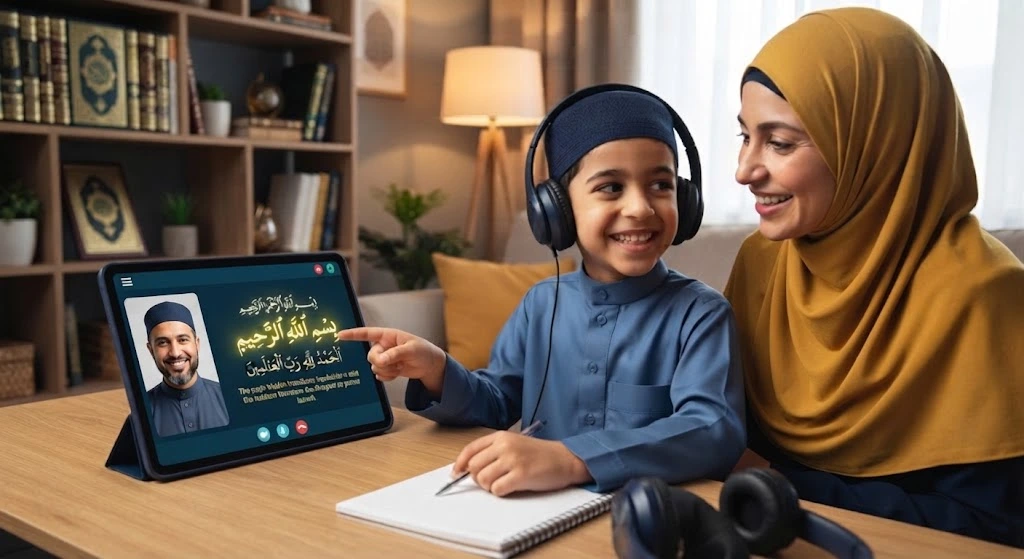

Why Is Your Child Struggling to Read the Quran? Every evening across the US, UK, Canada, Australia, and the Gulf, a familiar quiet tension settles into Muslim families’ living rooms. School is over, homework is supposedly done, and it is time for Quran practice. But instead of eager recitation, you are met with sighs, hesitation, and stumbling over Arabic letters. If your child struggles to read the Quran, you may wonder whether the problem is a lack of practice, an unsuitable learning method, or simply a need for more patience and guidance.
If your child is struggling to read the Quran, you are far from alone. Many parents watch their children freeze up over basic pronunciation, dread evening sessions, or lose confidence when comparing themselves to others in local classes.
Traditional mosque commutes, large group settings where shy children get left behind, and rigid teaching methods often exacerbate the problem, turning what should be a peaceful spiritual bond into a nightly battleground.
Here is the good news: when approached with the right environment, patient mentors, and modern online Quran classes for kids, even the most reluctant learners can transform their recitation, build genuine confidence, and actually look forward to their lessons.
Quick Summary & Key Takeaways
Identify the Root Cause: Recognizing whether your child struggles with Arabic phonetics (Makharij), letter recognition, or focus fatigue is the first step to a solution.
One-on-One Patience: Individual online tutoring eliminates peer pressure, giving children the undivided attention they need to overcome reading anxiety.
Interactive Tools: Digital Tajweed trackers, screen sharing, and positive reinforcement make learning feel engaging rather than burdensome.
Direct Access: For personalized support, expert evaluation, and free trial sessions, contact Farhat Academy via WhatsApp at +923005006505, visit www.farhatacademy.com, or email farhatacademy121@gmail.com.
Why Children Struggle to Read the Quran (And Why Traditional Settings Fail)
Before you can help your child, it helps to understand why the frustration is happening. When children stumble over verses, parents often assume a lack of effort. In reality, the barrier is almost always structural or psychological.
In crowded local madrasahs, teachers must divide their attention among 15 to 25 students. If a child has a slight hesitation with throat letters (like Ain or Haa) or struggles to connect disjointed Arabic script, they rarely get the repeated, gentle correction they need. Over time, embarrassment sets in, silence takes over, and the child starts associating Quran time with stress.
The Hidden Blocks Young Learners Face
Phonetic Disconnect: Arabic articulation points do not exist in English or Western languages, making proper sound production genuinely difficult without close-up visual and auditory modeling.
Cognitive Overload: Rushing through pages without mastering foundational Noorani Qaida rules creates a shaky foundation that collapses as verses get longer.
Evening Exhaustion: Trying to focus on intricate script after a full school day and a tiring commute leads to immediate mental fatigue.
The Online Solution: A Stress-Free Environment for Reluctant Readers
Shifting to structured online Quran classes completely alters the psychology of learning. At home, your child sits in a familiar, secure space without the anxiety of classroom comparison.
More importantly, dedicated one-on-one attention allows certified tutors to diagnose exact stumbling blocks instantly. If a child confuses similar-looking letters like Ba (ب), Ta (ت), and Tha (ث), a private online tutor can slow down, use digital annotation tools, and practice until the distinction clicks naturally.
Named Framework: The 3-Step Confidence Reset
To help a child who is struggling, experienced educators use The 3-Step Confidence Reset:
De-escalate the Pressure: Pause heavy memorization (Hifz) temporarily and return to foundational phonetics in relaxed, 20-minute micro-sessions.
Isolate and Conquer: Focus on mastering just one or two tricky Makharij per week using playful repetition rather than lengthy drills.
Celebrate Micro-Wins: Reward fluent reading of a single line with positive reinforcement, building positive neuro-associations with Quran study.
Comparing Learning Approaches: Traditional Madrasah vs. Online Tutoring
| Evaluation Criteria | Traditional Local Madrasah | Modern Online Quran Academy (e.g., Farhat Academy) |
| Attention Level | Shared among large groups; individual errors go unnoticed | 1-on-1 dedicated focus with instant pronunciation correction |
| Pace & Comfort | Rigid group speed; children feel rushed or left behind | Customized learning speed tailored to your child’s exact comfort level |
| Scheduling Flexibility | Inflexible evening slots requiring exhausting daily commutes | Seamless scheduling around school hours across US, UK, CA, and GCC |
| Teacher Matching | Limited strictly to local geographic availability | Access to elite certified Qaris and female mentors worldwide |
Image 2 Placement Marker: [Insert child-struggling-to-read-the-quran-guide.webp here showing the evaluation checklist and troubleshooting steps for reluctant readers].
Actionable Tips for Parents: How to Help at Home
As a parent, your role is not to act as a strict taskmaster, but as an encouraging coach.
Keep Sessions Short and Sweet: For struggling readers, 20 minutes of high-focus, positive practice is infinitely more effective than 60 minutes of frustrated staring at a page.
Incorporate Multisensory Tools: Use finger-tracking, audio repetition apps, and colorful Quranic flashcards to engage visual and tactile learning styles.
Partner with a Certified Professional: Trying to teach a resistant child yourself often strains parent-child dynamics. Handing the reins to a warm, highly trained online tutor preserves your relationship while ensuring expert guidance.
Frequently Asked Questions (FAQs)
Why is my child suddenly refusing to read the Quran?
Resistance usually stems from frustration, fatigue, or fear of making mistakes in front of peers. Switching to a private, one-on-one online setting removes peer pressure and restores their confidence through gentle, patient encouragement.
What age is best to intervene if a child struggles with reading?
Intervene as soon as you notice persistent hesitation or emotional resistance—typically around ages 5 to 8. Catching phonetic confusion early prevents bad recitation habits from becoming deeply engrained.
Are female online tutors available for young girls?
Yes. Reputable platforms like Farhat Academy provide certified female Quran teachers, ensuring young girls and teenagers feel completely secure, comfortable, and respected during their lessons.
How do online classes accommodate busy school schedules?
Online academies operate across global time zones with 24/7 flexibility. Sessions are scheduled effortlessly around your local school hours in the US, UK, Canada, Australia, or the Gulf.
How can I track my child’s daily reading progress?
Farhat Academy provides direct communication channels with tutors, regular performance updates, and milestone tracking so parents always know how their child is advancing.
Your Next 15-Minute Action Plan
Assess the Real Barrier: Talk gently with your child to discover whether letters, speed, or teacher pressure is causing their reluctance.
Contact Farhat Academy: Reach out via WhatsApp at +923005006505 or visit www.farhatacademy.com to discuss your child’s specific reading challenges.
Book a Risk-Free Trial: Experience a personalized trial session with a patient tutor and watch your child regain their reading confidence.